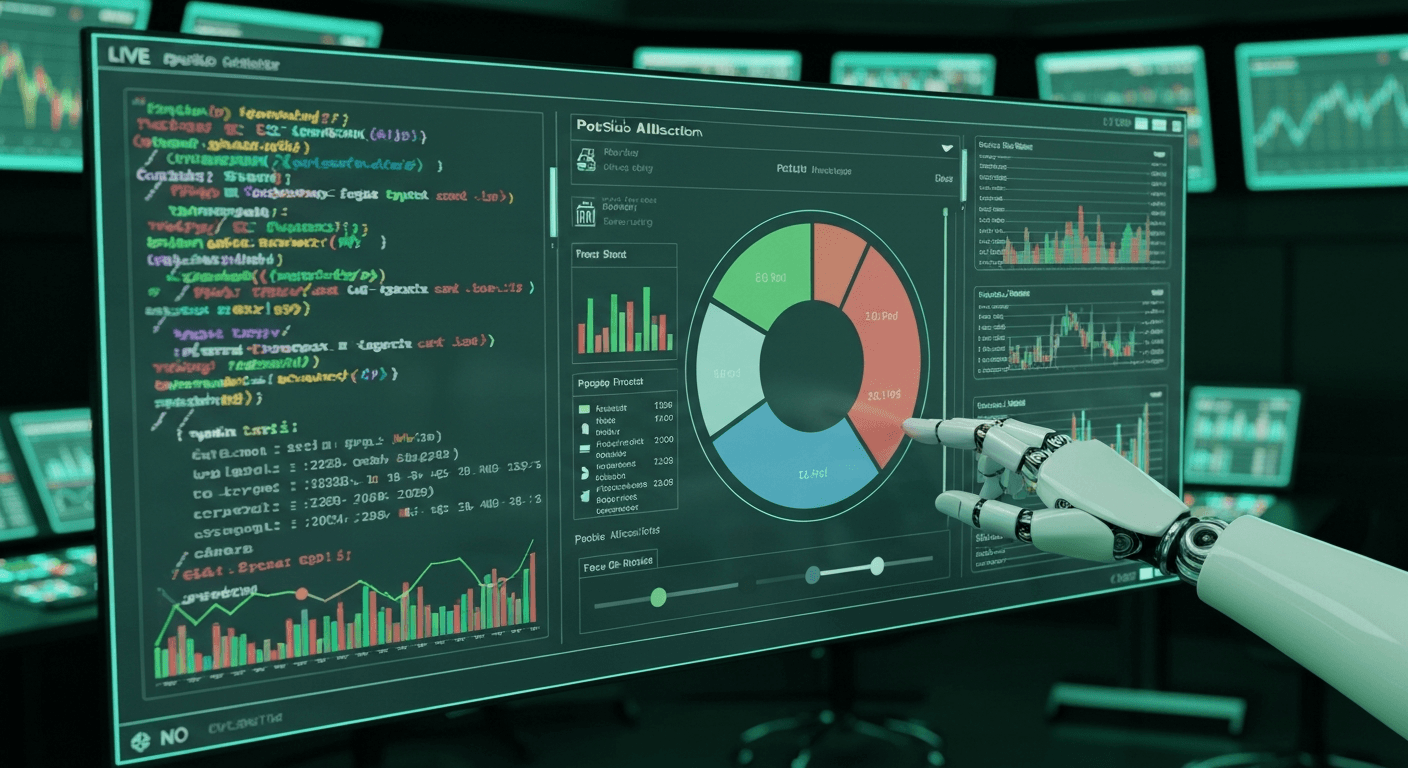
Automated Investment Hypothesis Generation Using Unstructured Data: Building a System to Discover Market Opportunities Through Patents, Academic Papers, and Regulatory Documents
Do you want to seize early market opportunities that are difficult to capture with traditional investment analysis methods? This article presents a practical method for building a system that automatically generates and validates investment hypotheses, surpassing human limitations, by analyzing vast amounts of unstructured data such as patents, academic papers, and regulatory documents using AI and NLP technologies. It will be a game-changer, enabling proactive and data-driven decision-making in an era of information overload.
1. The Challenge / Context
Today's investment market is changing faster than ever, and the amount of information is increasing exponentially. It is becoming increasingly difficult to capture the vast market trends, especially early-stage opportunities triggered by technological innovation or regulatory changes, through traditional financial statement analysis or news article monitoring alone. This inefficiency stems from the limitations of human analysts' time and cognitive abilities. Real-time analysis of countless patent documents, cutting-edge academic papers, and complex regulatory documents to read the hidden market signals and future trends within them is almost impossible.
However, this is precisely where the opportunity lies. The advancement of artificial intelligence and natural language processing (NLP) technologies, which can efficiently process and analyze vast amounts of unstructured text data, provides a clue to solving these problems. By leveraging these technologies to build a system that can automatically generate hypotheses about potential investment opportunities and even evaluate their likelihood without human intervention, we can gain a decisive advantage in the market. We are now in an era where such a proactive, data-driven approach is key to investment success.
2. Deep Dive: Core Principles of an Unstructured Data-Based Investment Hypothesis Generation System
An automated investment hypothesis generation system goes beyond simply collecting data; it focuses on identifying hidden meanings and relationships within unstructured data and deriving logical investment opportunities based on them. The core of this system consists of the following stages and technology stack:
- 데이터 수집 및 전처리 (Data Ingestion & Preprocessing): Raw data is collected from patent offices (KIPRIS, USPTO), academic databases (ArXiv, PubMed), and the Ministry of Government Legislation's National Law Information Center, among others. This process is essential for converting various document formats such as PDF, HTML, and XML into text, removing unnecessary noise, and normalizing the data.
- 정보 추출 및 임베딩 (Information Extraction & Embedding): Key entities necessary for investment decision-making, such as company names, technology names, people, regulatory clauses, and core concepts, are identified from the text (Named Entity Recognition, NER), and relationships between them are extracted. Additionally, embedding techniques (e.g., Sentence-BERT, Word2Vec) are used to map the meaning of entire documents or specific words/sentences into a vector space, calculating semantic similarity of text data and transforming it into a format that machine learning models can understand.
- 지식 그래프 구축 (Knowledge Graph Construction): Extracted entities and their relationships are connected as nodes and edges to build a knowledge graph. For example, it allows for visualizing and exploring complex relationships such as 'Company A' holds a 'patent' for 'Technology B', 'Technology B' is affected by 'Regulation C', and 'Regulation C' was issued by 'Government Agency D'. This is extremely useful for discovering hidden connections.
- 가설 생성 엔진 (Hypothesis Generation Engine): Potential investment hypotheses are generated based on the knowledge graph and embedding data. This can be based on specific rules (e.g., "Unlisted company X with a patent application increase of over 50% in a specific technology sector over the past 3 years") or by utilizing LLMs (Large Language Models) to analyze complex patterns and derive new insights. Furthermore, machine learning models can be used to detect anomalies such as changes in technology trends or regulatory signals.
- 가설 검증 및 랭킹 (Hypothesis Validation & Ranking): For the generated hypotheses, backtesting is performed by linking relevant financial or market data, or expert review is conducted to evaluate actual investment potential and prioritize them.
Through this process, the system can present specific investment hypotheses such as 'An increase in YY technology patents by XX company and related regulatory easing could be a new market growth driver.'
3. Step-by-Step Guide / Implementation
The process of building an unstructured data-based automated investment hypothesis generation system can be divided into several stages. Here, we explain the key steps from the perspective of utilizing Python-based open-source libraries.
Step 1: 데이터 수집 및 전처리 (Data Collection & Preprocessing)
First, it is necessary to collect and refine the raw data required for analysis. Patents, papers, and regulatory documents have different formats and sources, so a strategy tailored to each must be established.
- 특허 데이터: Utilize APIs from KIPRIS (Korea), USPTO (USA), etc., or use publicly available datasets. Patent documents in PDF format require text extraction.
- 학술 논문: Collect paper metadata and abstracts via ArXiv API, Semantic Scholar API, etc., or extract text from full PDF documents.
- 규제 문서: Obtain documents via API or web scraping from the Ministry of Government Legislation's National Law Information Center (Korea), legislation.gov.uk (UK), govinfo.gov (USA), etc.
After data collection, the following preprocessing steps are performed:
- 텍스트 추출: Extract text from PDF files (e.g., PyPDF2, pdfminer.six). For scanned documents, OCR (Optical Character Recognition, e.g., Tesseract) is used.
- 클리닝: Remove HTML tags, unnecessary special characters, and advertisements.
- 정규화: Perform tasks such as unifying